
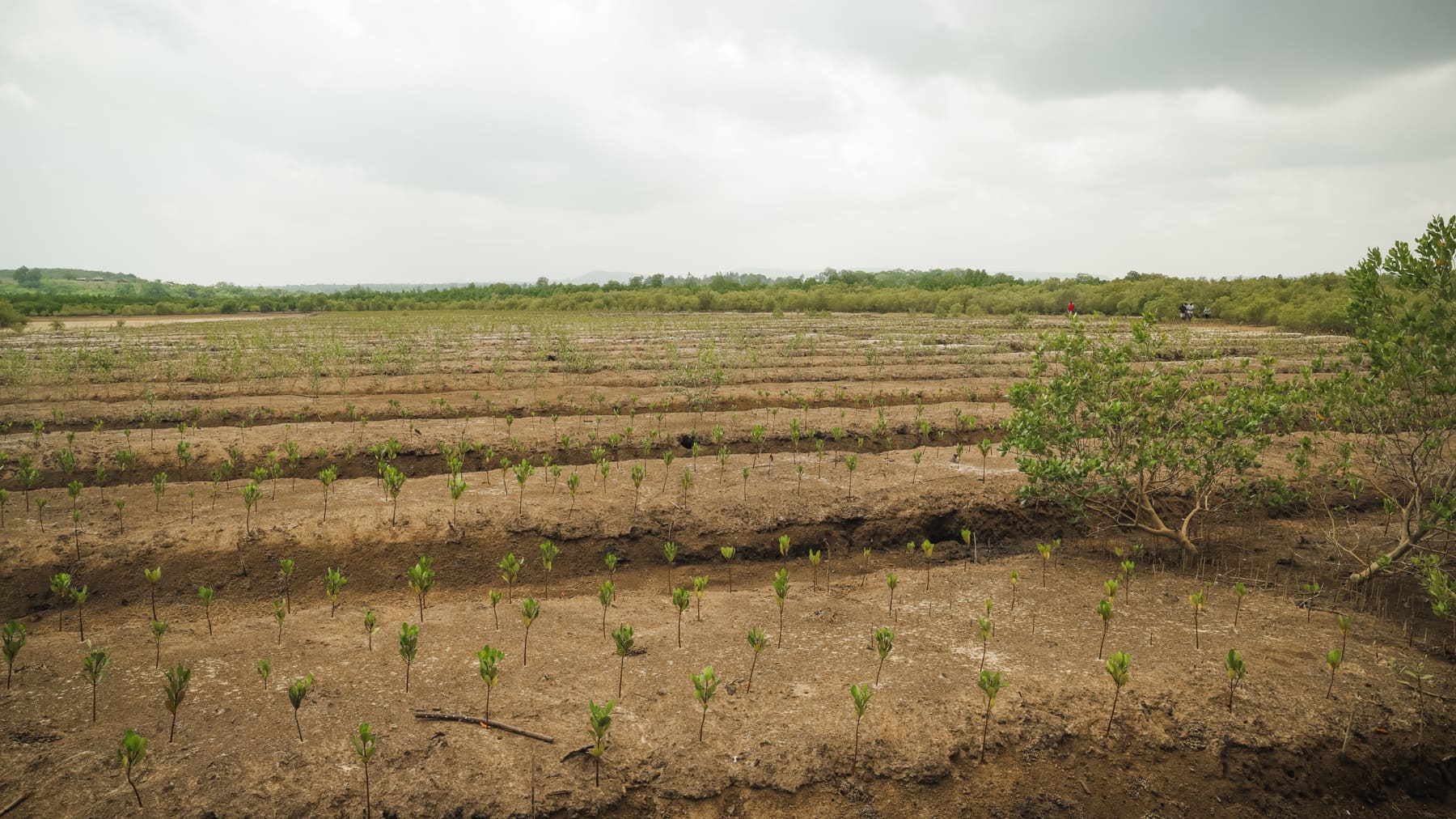
Along the Kenyan coast, EarthLungs stopped planting into dry ground and started rebuilding the tides. Over 100 kilometres of trenches later, restoration looks very different.
Mangrove forests are among the most valuable coastal ecosystems on Earth. They buffer shorelines against ocean/sea-to-inland storms and erosion, support rich biodiversity, and store vast amounts of carbon. Yet these ecosystems have faced relentless degradation from human activity and hydrological disruption, making traditional restoration methods less effective without addressing underlying environmental conditions.
Recognising this challenge, EarthLungs pioneered a simple but powerful innovation: the systematic use of trenches to restore natural hydrological connectivity in degraded mangrove sites. Over time, this innovation has reshaped how restoration is done along Kenya’s and East Africa’s coast, turning inhospitable terrain into thriving mangrove forests.
Why Hydrology Matters
Mangroves thrive in the intertidal zone, an environment governed by the ebb and flow of tides that bring in sediments, nutrients, and propagules while flushing excess salts and improving soil conditions. When hydrological connectivity is disrupted, whether by sedimentation, human infrastructure, or altered tidal flow, mangrove seedlings struggle to establish, and planted saplings often fail to survive. Research consistently shows that successful restoration depends on re-establishing the right water dynamics, not just planting trees.
This scientific insight became the foundation for EarthLungs’ trenching strategy, a method that moves beyond tree planting and into ecosystem engineering.
EarthLungs’ Trenching Innovation
In the early stages of large-scale restoration, EarthLungs teams observed that many degraded sites remained dry and disconnected from tidal influence. In response, they developed an approach to excavate networks of trenches, channels designed to reconnect these areas with tidal waters. These trenches act as artificial creeks, bringing saltwater and sediment into degraded zones while improving soil conditions for mangrove establishment.
To date, EarthLungs has engineered over 100 kilometres of trenches across key restoration sites, just to mention a few:
- Siji Bombo: 22.453 km of trenches excavated
- Mandharini: 16.423 km
- Mteza: 30.456 km
- Mwakirunge: 9.046 km
While these numbers refer to the total trench network rather than linear distances, they reflect the extensive effort involved in re-shaping hydrological pathways across varied terrain.
This approach not only ensures that water reaches formerly isolated areas but also creates conditions conducive to the natural recruitment of propagules and healthier sapling establishment. Trenches flush out excess salinity, reduce stagnant water, and allow tidal influence to follow historic patterns that mangroves evolved with, all essential factors for successful restoration.
From Field Innovation to Field Impact
The impact of trench-based restoration goes beyond scientific theory. In the field, it has changed the way EarthLungs and its community partners approach degraded coastal zones. Rather than planting seedlings into dry, inhospitable ground, teams now focus on restoring hydrological connectivity first, a step that dramatically increases the likelihood that natural processes will take over.
“Trenches have been a game changer in mangrove restoration, they turn places that look dead into places where nature returns.”
This sentiment resonates across the sites where trenching is used, from creek margins to wide coastal flats.
Beyond environmental benefits, trenches also create roles and responsibilities for local communities. EarthLungs’ method involves hands-on work in excavation and monitoring, providing opportunities for local engagement, employment, and stewardship. This blend of ecological function and socio-economic inclusion aligns with community-based restoration principles that have proven effective in mangrove management globally.
Shaping the Future of Mangrove Restoration
Today, trenching is no longer an isolated technique. Restoration practitioners increasingly recognise that simply planting trees without addressing hydrology often leads to poor outcomes. By contrast, trench-based restoration helps mimic natural tidal patterns, creating dynamic environments where mangroves can survive, grow, and flourish.
For EarthLungs, the lesson is clear: restoration must work with nature, not around it. Trenches are not just channels in the soil. They are channels for life to return. They represent adaptive, science-aligned restoration that acknowledges the complexity of mangrove ecosystems and the need for solutions that are both effective and grounded in local environmental realities.
As EarthLungs continues to refine and expand this approach, the hope is that trenching will become standard practice in coastal restoration, not only in East Africa but wherever mangroves are threatened, and communities depend on their survival.